
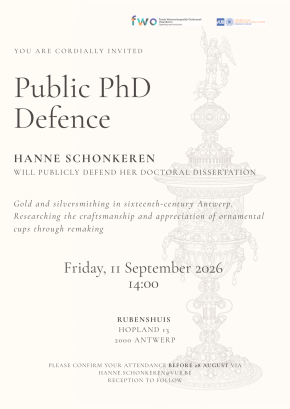
On Friday, 11 September, VISU member Hanne Schonkeren will publicly defend her doctoral dissertation 'Gold and silversmithing in sixteenth-century Antwerp. Researching the craftsmanship and appreciation of ornamental cups through remaking.'
The defence starts at 14:00, will take place at the Rubenshuis (Hopland 13, 2000 Antwerp) and will be followed by a reception. Please confirm your attendance before 28 August by emailing to hanne.schonkeren@vub.be. See more information about the dissertation below:
Abstract
This doctoral thesis investigates ornamental cups (coupe d’apparat; pronkbekers) made in sixteenth-century Antwerp, objects that were not solely practical vessels, but spectacular displays of wealth, commemorative pieces, and powerful instruments of social exchange. During Antwerp’s commercial and artistic heyday, the city became the leading centre of gold and silversmithing. Socio-economic historians have studied the Antwerp art of gold and silversmithing, and museums have successfully identified Antwerp-made objects; however, we know far less about how they were actually made, who made them, and how the skills of individual craftsmen shaped their appearance and value.
This thesis approaches Antwerp cups not simply as precious objects, but as the products of highly skilled hands and complex workshop practices. To recover this largely invisible dimension of their history, the research combines archival sources and art-historical literature with the experimental method of remaking: selected details and techniques of these cups are recreated by hand. Reconstructing the process makes it possible to see what finished objects conceal: the sequence of operations, the tools and skills involved, the decisions made along the way, and the different levels of craftsmanship required to transform raw precious metal into a highly elaborate vessel.
The results reveal a distinctive Antwerp technical repertoire, particularly in the use of chasing and repoussé, and point to workshops that were far more inventive than the finished objects might suggest. Antwerp makers demonstrated highly flexible workshop practices by reusing models, ingeniously assembling different elements, and collaborating across stages of production. The cup therefore emerges not as the work of an isolated master, but as the outcome of a dynamic network of skills, materials, models, and makers.
By bringing making back into the investigation of early modern gold and silversmithing, this thesis offers a new way of understanding why these objects mattered. Their value lay not only in the precious and exotic materials, in the gold and silver, but also in the knowledge, diligence, and craftsmanship embedded within them. In doing so, the thesis challenges the traditional separation of the so-called “decorative arts” from “fine arts” and argues for a broader understanding of gold and silversmithing as a fundamental part of Renaissance culture.